
Rheumatoid arthritis and the heart: study identifies six cardiovascular risk profiles
Rheumatoid arthritis and the heart: study identifies six cardiovascular risk profiles
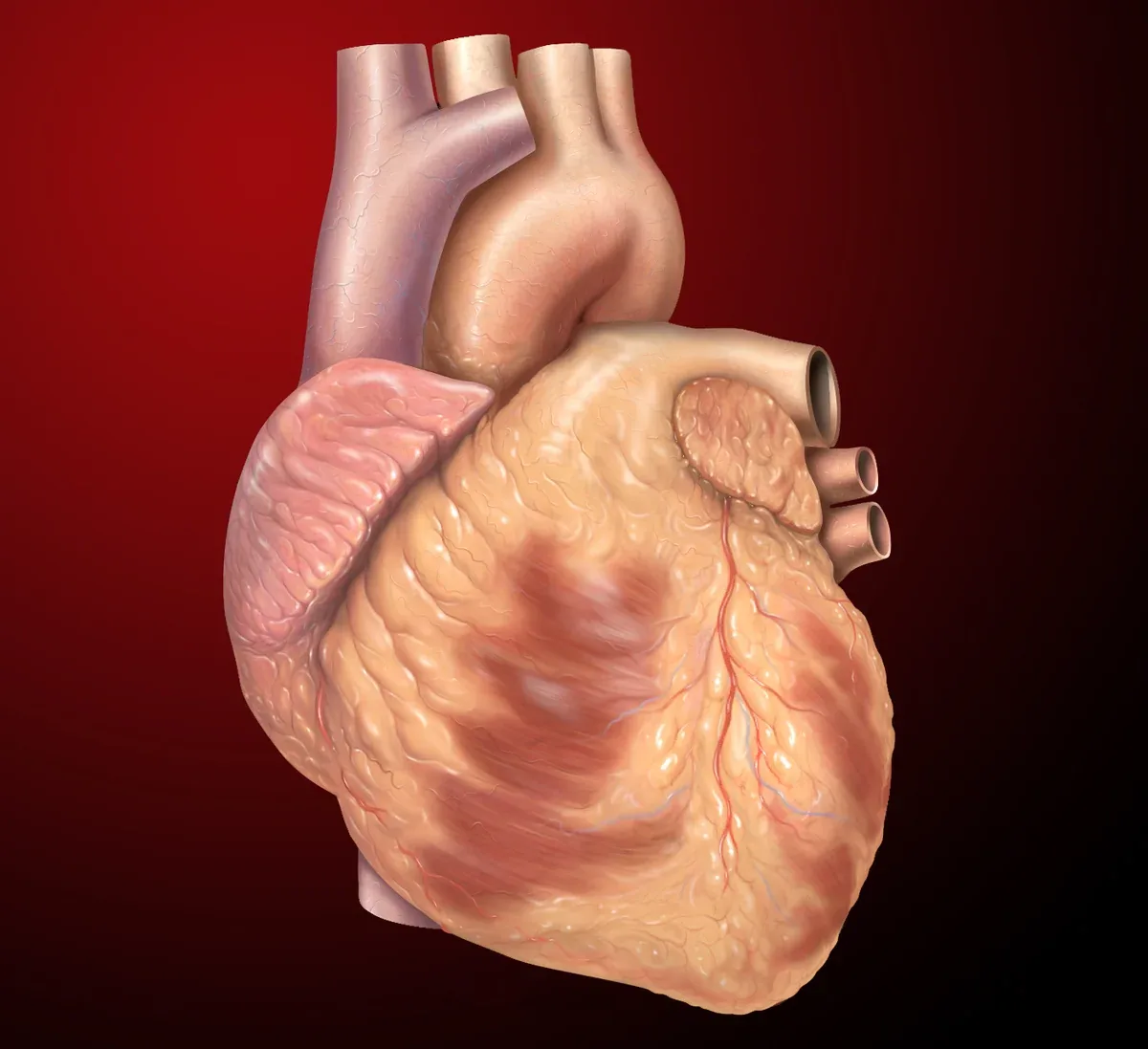
Image: anatomical illustration of the heart, anterior exterior view, by Patrick J. Lynch, medical illustrator, published on Wikimedia Commons under a CC BY 2.5 license (image resized). It is a reference illustration and does not come from the study cited in this article.
Rheumatoid arthritis is a chronic autoimmune disease that inflames the joints —hands, wrists, knees— and, when uncontrolled, can damage other organs as well. Among its less visible complications is the heart: people with rheumatoid arthritis experience cardiovascular disease more often, and it is one of the leading causes of illness and premature death in this group. A recent study asked whether that risk is the same for everyone with the disease or whether, instead, there are distinct profiles worth knowing in order to guide prevention and treatment.
This article summarizes what the study reported, with its primary source, its dates, and its limitations. It does not replace a health professional’s assessment of any treatment.
Editorial warning: this content is for informational purposes and does not replace the guidance of a health professional. For any clinical question, diagnosis, or treatment, the decision belongs to qualified medical personnel.
What was studied, and with what data
The study analyzed 3,252 adults aged 20 years or older with self-reported rheumatoid arthritis, drawn from the National Health and Nutrition Examination Survey (NHANES) for the 2005–2018 cycles. Using these data, the authors applied an unsupervised clustering method (partitioning around medoids with Gower distance) combining metabolic, inflammatory, renal, behavioral, and psychosocial factors, aiming to identify profiles —phenotypes— of cardiovascular risk within the rheumatoid arthritis population.
The validity of the groups was assessed with silhouette analysis and internal validation on training and testing subsets. Then, using survey-weighted binary logistic regression, the authors estimated the association between belonging to each profile and having diagnosed cardiovascular disease.
This work was posted as a preprint on medRxiv on September 17, 2026, and, at the time of this publication, has not undergone peer review. Its findings may be revised once formally reviewed.
Six cardiovascular risk profiles in rheumatoid arthritis
The analysis identified six clinically interpretable profiles. According to the study’s abstract, the proportion of people with already-diagnosed cardiovascular disease varied notably between them:
- Severe Metabolic–Diabetic — the profile with the heaviest burden of cardiovascular disease (40.3%).
- Aging Diabetic–Hypertensive — 34.9% with cardiovascular disease.
- Non-Diabetic Intermediate — 20.2%.
- Smoking-Predominant — 19.4%.
- Mild Metabolic — 14.8%.
- Cardiometabolic — the reference profile, at 10.4%.
The central takeaway is that cardiovascular risk in rheumatoid arthritis is not uniform: it concentrates in profiles where metabolic factors (such as diabetes, hypertension, or smoking) coincide with the inflammation characteristic of the joint disease.
Results: which profiles carried the most risk
Comparing each profile against the cardiometabolic reference profile, the study found marked differences in the odds of having cardiovascular disease:
- The Severe Metabolic–Diabetic profile showed the strongest association: 4.11 times greater odds (95% confidence interval: 2.56 to 6.59).
- Next came the Aging Diabetic–Hypertensive profile, with 3.38 times greater odds (95% CI: 2.22 to 5.15).
- The Smoking-Predominant profile had 1.99 times greater odds (95% CI: 1.26 to 3.13).
- And the Non-Diabetic Intermediate profile, 1.77 times greater odds (95% CI: 1.10 to 2.84).
The six-cluster solution showed moderate separation and strong internal correspondence between training and testing sets; the phenotype-informed model achieved moderate discrimination for prevalent cardiovascular disease (AUC = 0.72). These figures are adjusted odds ratios (aORs): they compare the odds of one group against another after accounting for the factors included in the model. The 95% confidence interval indicates the range where the true value likely falls; when that range does not cross 1, the difference is considered statistically relevant.
What this may mean for prevention and treatment
The study’s message is not that rheumatoid arthritis dooms everyone to the same cardiovascular risk, but the opposite: among people living with this joint disease, risk is distributed unevenly according to the combination of inflammation, metabolic factors, and habits such as smoking. The authors themselves suggest that a phenotype-based approach could offer a more comprehensive framework for characterizing multidimensional cardiovascular risk in rheumatoid arthritis.
For clinical care, the underlying idea is that controlling joint inflammation and caring for classic risk factors —blood pressure, glucose, smoking— may be complementary fronts of the same strategy. This is one reading of the study, not a recommendation: which prevention or which treatment applies in each case is decided solely by the treating physician, considering each person’s complete medical history.
Limitations of the study
- It is a preprint. It has not yet been peer-reviewed or published in a scientific journal; its figures could be adjusted after review.
- The data come from the United States (the NHANES survey), with its own population and health system. The general patterns are a useful reference, but they should not be automatically transferred to Mexico without local evidence.
- Rheumatoid arthritis was self-reported by participants, not confirmed from clinical records or by a joint specialist’s assessment, which may mix different disease profiles together.
- It is a cross-sectional analysis of prevalence: it measures association at a single point in time; it does not prove that belonging to a profile causes cardiovascular disease.
- The model’s discrimination (AUC = 0.72) is moderate: the profiles help describe risk but do not predict it perfectly.
Frequently asked questions
Does rheumatoid arthritis affect the heart?
It can be accompanied by higher cardiovascular risk. The chronic inflammation characteristic of the disease —although its most visible manifestation is in the joints— is associated with more cardiovascular disease in several studies. This work adds that, within rheumatoid arthritis, risk varies greatly depending on each person’s profile. Any specific concern about the heart should be assessed with a health professional.
Does treating rheumatoid arthritis also protect the heart?
This study does not measure that: it did not compare treatments or evaluate changes in risk over time. Its focus was describing risk profiles from clinical and lifestyle factors. Decisions about treatment —including how it relates to cardiovascular health— belong to the treating physician.
What is a preprint, and why does it matter here?
A preprint is a scientific paper published before peer review, the process in which other specialists evaluate the methodology and results before formal publication. A preprint can be a useful early data point, but it deserves more caution than an already-reviewed study, and it should always be flagged as not yet having gone through that filter.
Do these results apply directly to Mexico?
Not automatically. The study is based on data from the United States national health survey. The general findings —that cardiovascular risk concentrates where inflammation, metabolic factors, and smoking coincide— are a reasonable reference, but they do not replace local data where it exists.
Where can I read the full study?
The preprint is publicly available on medRxiv: Cardiometabolic and Psychobehavioral Phenotypes Define Cardiovascular Risk Heterogeneity in Rheumatoid Arthritis (Shah et al., posted September 17, 2026).
How we work with this source at Medical MX
At Medical MX we collect and organize medical information from open sources, including scientific research published in publicly accessible repositories such as medRxiv. When the source is a preprint, we explicitly flag it as such, state its publication date, and avoid presenting its figures as definitive conclusions. This article does not offer treatment recommendations: it summarizes what the study reported and points to the original source for anyone who wants to review it in detail.
Conclusion
This analysis of NHANES data found that, among adults with rheumatoid arthritis, cardiovascular risk is not uniform: six profiles defined by a combination of metabolic, inflammatory, renal, behavioral, and psychosocial factors showed very different burdens of disease, and the severe metabolic–diabetic and diabetic–hypertensive profiles concentrated the highest probability of already-present cardiovascular disease. It is a relevant descriptive finding for understanding the cardiovascular health of people living with this joint disease, presented here with its source, its date, and its limitations, as our methodology requires.
This article is for informational purposes and does not replace the assessment of a health professional. The verification date of this source is recorded alongside its publication, and any update will be accompanied by the corresponding reference.