
COVID-19 in people with rheumatoid arthritis and other autoimmune diseases: findings from a population-based study
COVID-19 in people with rheumatoid arthritis and other autoimmune diseases: findings from a population-based study
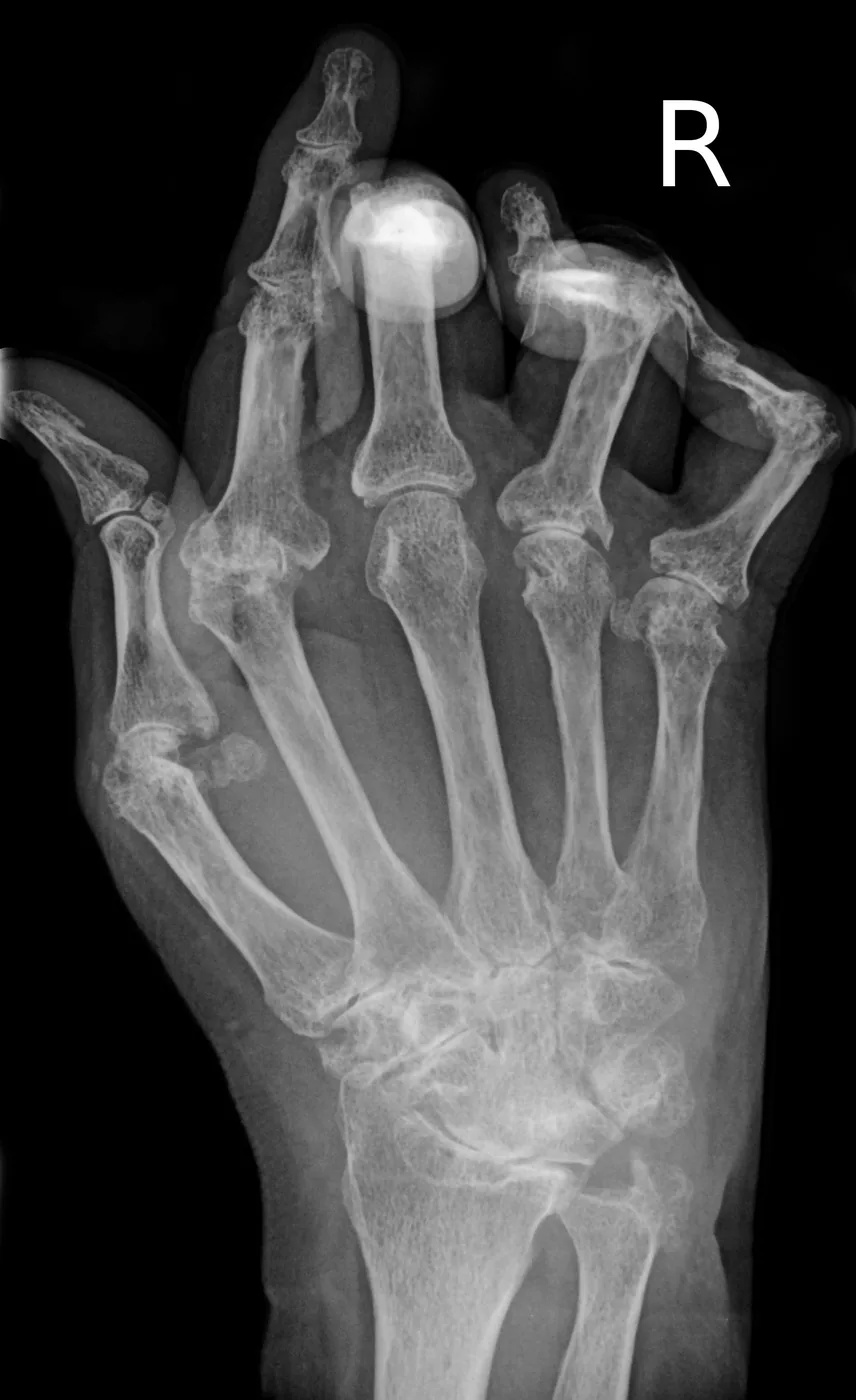
Image: X-ray of a hand with rheumatoid arthritis, courtesy of Bernd Brägelmann (“Braegel”), published on Wikimedia Commons under a CC BY 3.0 license (image resized). It does not correspond to any participant in the study cited in this article.
Rheumatoid arthritis, systemic lupus erythematosus, and psoriatic arthritis are autoimmune rheumatic diseases that inflame the joints and, in many cases, are managed with treatments that modulate the immune system. During the pandemic, a specific question emerged: did these individuals face a different risk from COVID-19 than the general population? A population-based study covering nearly 5.2 million people in Quebec, Canada, offers concrete data on this question.
This article summarizes what the study reported, with its primary source, its dates, and its limitations. It does not replace a health professional’s assessment of any treatment.
Editorial warning: this content is for informational purposes and does not replace the guidance of a health professional. For any clinical question, diagnosis, or treatment, the decision belongs to qualified medical personnel.
What was studied, and with what data
The study is a population-based cohort investigation that used administrative health databases from Quebec to compare three groups of adults over 18 years old between March 2020 and April 2023:
- 81,434 people with systemic autoimmune rheumatic diseases (SARDs), including rheumatoid arthritis, psoriatic arthritis, and systemic lupus erythematosus.
- 2,020,356 people with other chronic conditions (comorbidities) but without an autoimmune rheumatic disease.
- 3,144,700 people with no recorded comorbidities.
The authors split the period into three pandemic phases — pre-vaccination, vaccination but pre-Omicron, and the Omicron period — and calculated the risk of infection, hospitalization, and ICU admission or death, adjusted for age and sex.
This work was posted as a preprint on medRxiv on September 22, 2026, and, at the time of this publication, has not undergone peer review. Its findings may be revised once formally reviewed.
Results: similar infection risk, but more hospitalizations
A first finding is that SARS-CoV-2 infection rates, once adjusted for age and sex, were similar across the three groups. The difference appeared in severity: people with autoimmune rheumatic diseases had a markedly higher risk of hospitalization and of ICU admission or death compared with people without comorbidities.
During the pre-vaccination phase (March–December 2020), the adjusted risk of hospitalization was 3.4 times higher (95% confidence interval: 2.8 to 4.1) and the risk of ICU admission or death was 4.0 times higher (95% CI: 2.8 to 5.7). That gap did not close in later phases of the pandemic: during the Omicron period (December 2021–April 2023), the risk of hospitalization remained 4.5 times higher (95% CI: 4.0 to 4.9) and the risk of ICU admission or death, 4.4 times higher (95% CI: 3.6 to 5.4).
These figures are “adjusted hazard ratios” (aHRs): they compare the risk in one group against another after accounting for age and sex. The 95% confidence interval indicates the range where the true value likely falls; when that range does not cross 1, the difference is considered statistically relevant.
Which diseases and treatments concentrated the most risk
Within the group with autoimmune rheumatic diseases, rheumatoid arthritis, psoriatic arthritis, and systemic lupus erythematosus contributed the most to the burden of severe cases. One finding the authors themselves highlight: younger people with rheumatoid arthritis had hospitalization and mortality rates comparable to those of healthy older adults without the disease.
The subgroup with the highest risk was people treated with rituximab or mycophenolate, two immunosuppressive treatments used to control severe autoimmune diseases. In that subgroup, the adjusted risk of hospitalization reached 11.9 times higher (95% CI: 9.9 to 14.3) and the risk of ICU admission or death, 17.6 times higher (95% CI: 13.0 to 23.9), with the sharpest difference during the Omicron period.
This does not mean that a person should stop or change their immunosuppressive treatment on their own: these medications are prescribed precisely to control diseases that, left untreated, also carry serious risks. Any decision to continue, adjust, or pause a treatment belongs exclusively to the treating physician, together with the patient.
Limitations of the study
- It is a preprint. It has not yet been peer-reviewed or published in a scientific journal; its figures could be adjusted after review.
- The data come from Quebec, Canada, a health system and population different from Mexico’s. The general patterns (higher risk with strongly immunosuppressive treatments) tend to replicate across countries, but the exact risk figures should not be automatically transferred to another context without further local evidence.
- It uses administrative data, not complete clinical records: useful for measuring large population trends, but with less detail on each individual’s disease activity.
- The study measures a statistical association, not a single proven cause: other unmeasured factors could contribute to part of the observed difference.
Frequently asked questions
What is a preprint, and why does it matter here?
A preprint is a scientific paper published before peer review, the process in which other specialists evaluate the methodology and results before formal publication. A preprint can be a useful early data point, but it deserves more caution than an already-reviewed study, and it should always be flagged as not yet having gone through that filter.
Should I stop my immunosuppressive treatment because of this study?
No. The study does not recommend stopping any treatment; it describes a population-level risk observed during the pandemic. Decisions about immunosuppressive treatment — including questions about vaccination, extra precautions, or adjustments — belong to the treating physician.
Do these results apply directly to Mexico?
Not automatically. The study was conducted in Quebec, Canada, with its own health system and population. The findings are a useful reference point, but they do not replace local data where it exists.
Where can I read the full study?
The preprint is publicly available on medRxiv: Comparative Burden of COVID-19 in Adults with Rheumatic Diseases and Immunocompetent Individuals: A Population-Based Cohort Study in Quebec, Canada, 2020-2023 (Carazo et al., posted September 22, 2026).
How we work with this source at Medical MX
At Medical MX we collect and organize medical information from open sources, including scientific research published in publicly accessible repositories such as medRxiv. When the source is a preprint, we explicitly flag it as such, state its publication date, and avoid presenting its figures as definitive conclusions. This article does not offer treatment recommendations: it summarizes what the study reported and points to the original source for anyone who wants to review it in detail.
Conclusion
This population-based study in Quebec found that, although the risk of contracting COVID-19 was similar between people with and without autoimmune rheumatic diseases, the risk of hospitalization and severe outcomes was considerably higher among those living with rheumatoid arthritis, lupus, or psoriatic arthritis — especially under strongly immunosuppressive treatments such as rituximab or mycophenolate — and remained elevated throughout the pandemic, including the Omicron period. It is a relevant finding for public health surveillance, presented here with its source, its date, and its limitations, as our methodology requires.
This article is for informational purposes and does not replace the assessment of a health professional. The verification date of this source is recorded alongside its publication, and any update will be accompanied by the corresponding reference.